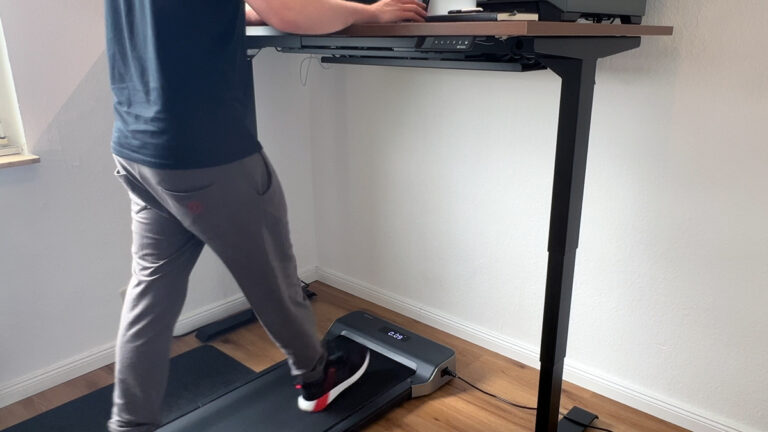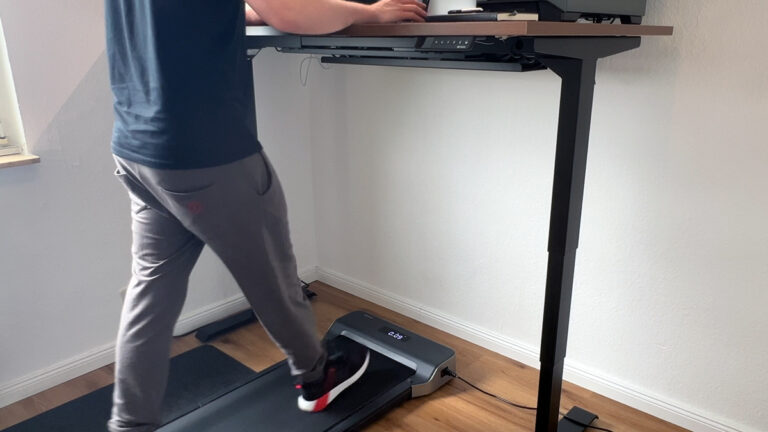

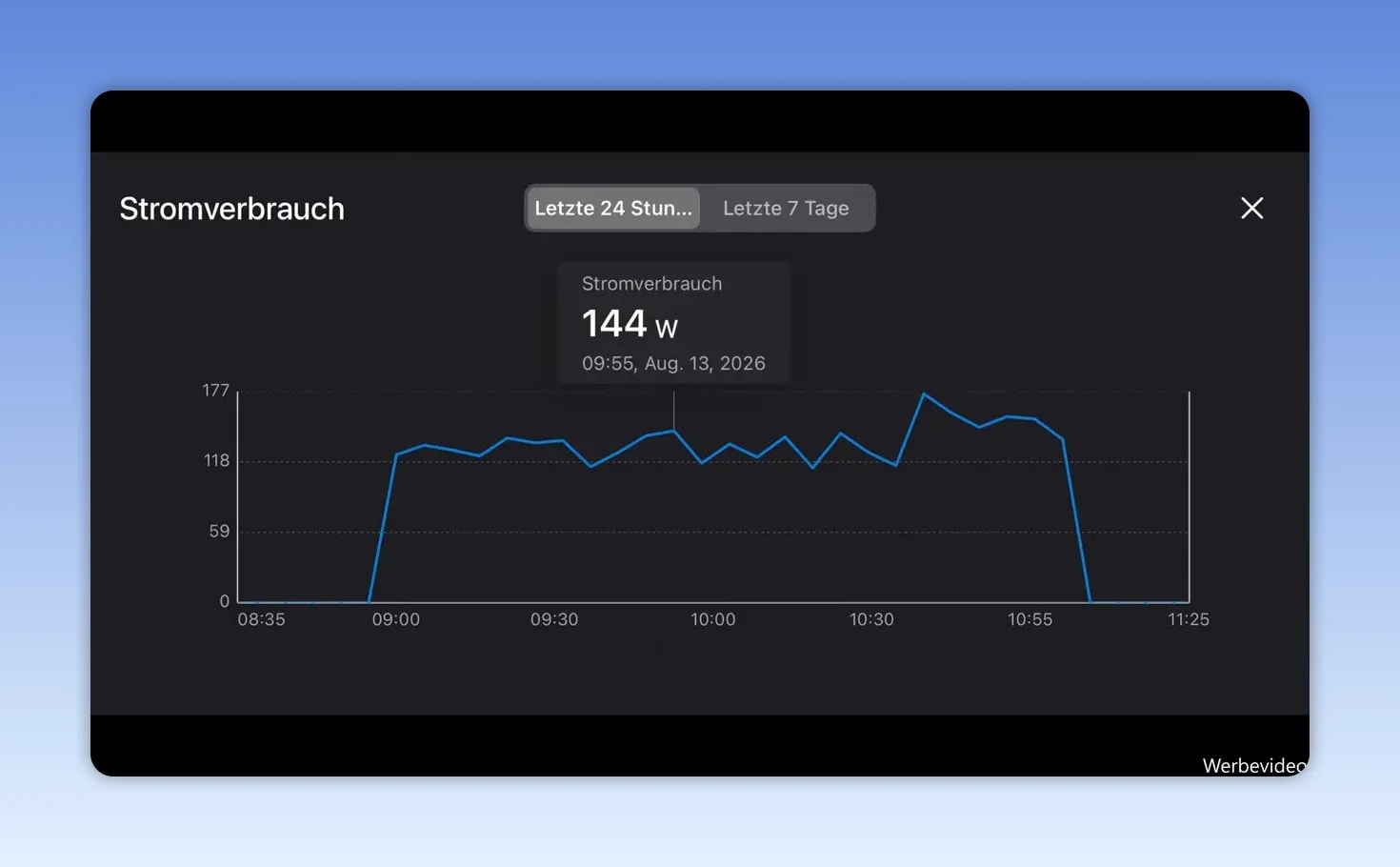
A walking pad in the home office quickly runs two hours a day. So the question of what that does to the electricity bill is an obvious one. For a long time there were only manufacturer figures for motor power, which have little to do with actual consumption. That is why I measure with a power meter in my newer tests what one hour of walking really costs. Here are the values and the maths behind them.
In short
When walking at 3 to 4 km/h, a walking pad uses about 0.13 to 0.15 kilowatt hours per hour. At an electricity price of 40 cents per kilowatt hour that is around 5 to 6 cents per hour, or about 1.80 euros a month at one hour a day. The motor power of 500 to 1,300 watts on the label is the peak output, not the continuous consumption.
Measured consumption from my tests
| Model | Measurement | Measured consumption | Converted per hour |
| KUIPERS K1 (German review) | around 2 hours of walking at the desk | 0.271 kWh | approx. 0.14 kWh |
| WalkingPad X214 | 2 hours at 3.3 km/h on average | under 0.3 kWh | approx. 0.15 kWh |
| WalkingPad X218 | 30-minute interval program with running | 0.13 kWh | approx. 0.26 kWh |
| KUIPERS K1 | 30-minute training program with pace changes | 72 Wh | approx. 0.14 kWh |
On the K1 the power draw while walking was between roughly 130 and 175 watts depending on the pace. On the X218 consumption doubles in the interval program with running sections, because the motor has to work much harder at 10 km/h and above and a fan joins in.
What one hour of walking costs
| Use | Consumption | Cost at 40 ct/kWh | Cost at 30 ct/kWh |
| 1 hour of walking (3 – 4 km/h) | approx. 0.15 kWh | approx. 6 cents | approx. 4.5 cents |
| 1 hour of jogging (10 km/h) | approx. 0.26 kWh | approx. 10 cents | approx. 8 cents |
| 1 hour daily, one month | approx. 4.5 kWh | approx. 1.80 euros | approx. 1.35 euros |
| 2 hours daily, one year | approx. 110 kWh | approx. 44 euros | approx. 33 euros |
For comparison: a fridge uses a similar amount or more per year depending on size and efficiency class. A walking pad is therefore one of the cheapest fitness devices to run. Electricity costs are no argument against buying one, the device just has to be used. Convert the figures to your local rate, the consumption stays the same.
Why the motor wattage says nothing about consumption
The label shows values like 550, 932 or 1,286 watts. That is the maximum power the motor can deliver, for example when starting with a heavy user or when sprinting. When walking evenly, the motor runs far below that limit. A stronger motor does not use more power when walking, it just works more comfortably. The X214 with 932 watts came in at around 0.15 kWh per hour in the test, the K1 with a maximum of 1.5 hp at around 0.14 kWh.
What actually affects consumption
- Speed: The biggest factor. From 3 to 10 km/h consumption roughly doubles.
- Body weight: More load means more friction and more motor work.
- Lubrication: A dry belt raises friction. Regular oiling with silicone oil lowers consumption and protects the motor.
- Fan: Models with a cooling fan like the A1 Pro draw slightly more power once the fan runs.
- Standby: Switched off, the device draws practically nothing. To be sure, switch off the main switch.
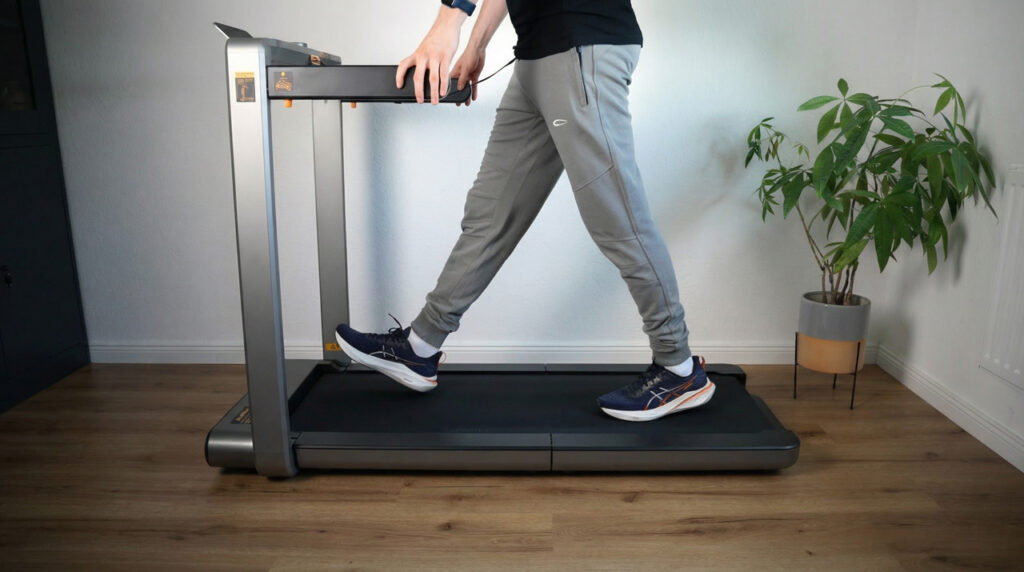
WalkingPad X214 Review The Best Upgrade for Home Office & Running?
Advertising: The product was provided to me for testing. My review remains unbiased and is based solely on my own experience and…
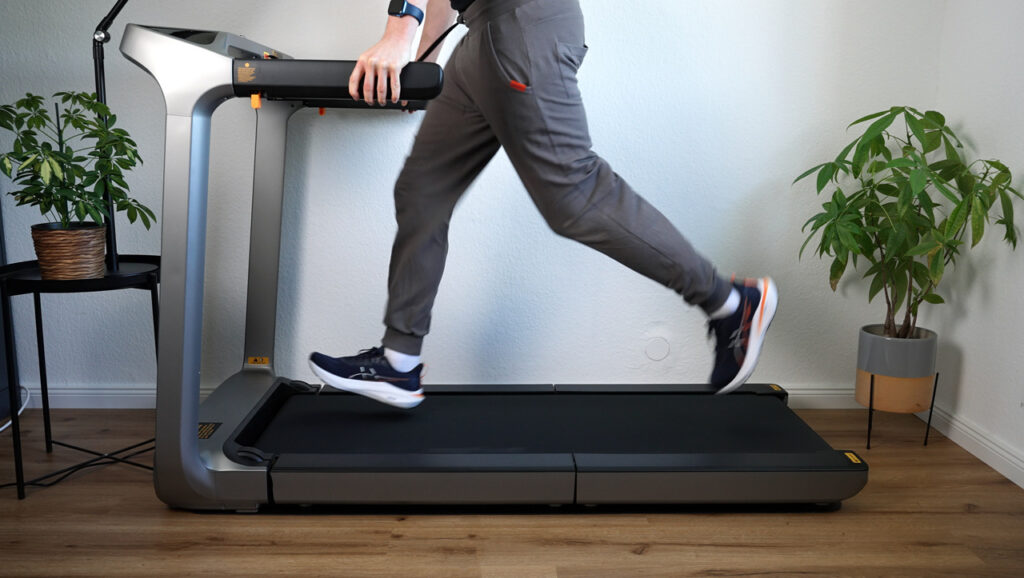
WalkingPad X218 Review The Fastest Folding Treadmill for Home
Advertising: The product was provided to me for testing. My review remains unbiased and is based solely on my own experience and…
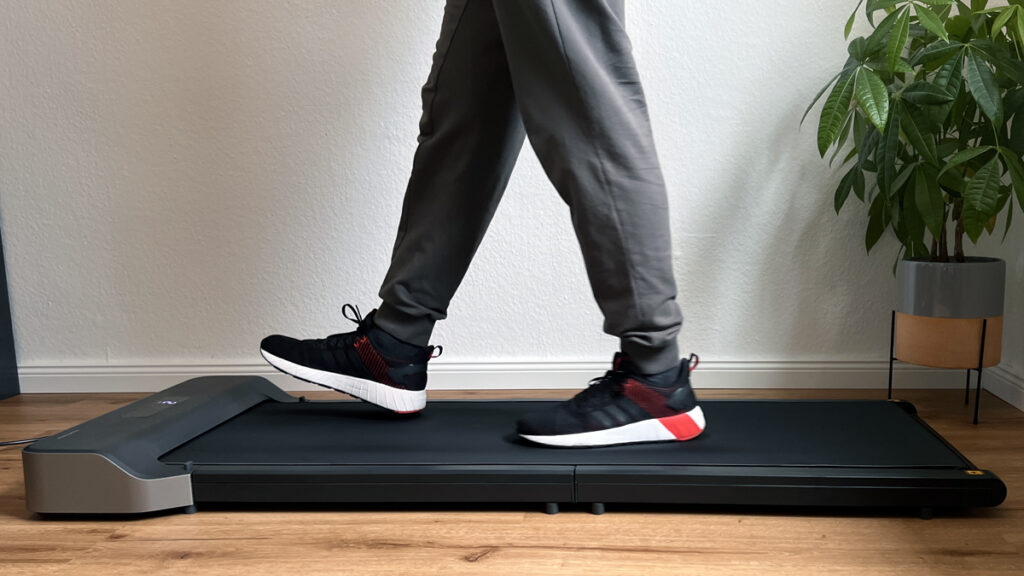
WalkingPad Z1 Review The Perfect Walking Pad for Most People!
Advertising: The product was provided to me for testing. My review remains unbiased and is based solely on my own experience and…
Walking pad without electricity: does it exist?
I get this question a lot. All walking pads in my tests have a motor and need a power socket. Manual treadmills without a motor, where the belt only moves through your own steps, are a different class of device: usually curved, much larger and heavier treadmills for sport, not flat pads for the desk. For walking while working they are unsuitable because you have to drive the belt yourself the whole time. If you are asking because of electricity costs, the answer is above: a walking pad costs a few cents per hour to run.
My verdict
Around 6 cents per hour of walking is negligible. More important than consumption are noise, walking feel and whether the device really gets used every day. All measurements are in the linked reviews and in my walking pad reviews.
Frequently asked questions about walking pad power consumption
How much electricity does a walking pad use per hour?
When walking at 3 to 4 km/h about 0.13 to 0.15 kWh. The KUIPERS K1 used 0.271 kWh in around two hours, the WalkingPad X214 under 0.3 kWh.
What does an hour on the walking pad cost?
At 40 cents per kilowatt hour around 6 cents when walking and around 10 cents when jogging at 10 km/h.
Does a stronger motor use more electricity?
No. The wattage is the peak output. When walking evenly every motor runs far below it, what matters are pace, weight and lubrication.
Are there walking pads without electricity?
All tested walking pads have a motor. Manual treadmills without a motor are larger sports devices that are not suited to walking at the desk.