
“Walking pad without electricity” is one of the most common searches around under-desk treadmills. Behind it are usually two wishes: no cable at the workstation and no electricity costs. Both can be answered, but differently than many expect. Here I explain what actually exists without a motor, why that does not work for the desk and how little a walking pad with electricity really uses.
In short
A walking pad in the proper sense, a flat treadmill for walking at the desk, only exists with a motor and a power socket. Manual treadmills without electricity are curved, large and heavy sports devices on which the belt only moves through your own drive. They are not suitable for working. The good news: a walking pad uses only around 0.15 kilowatt hours per hour of walking, about 6 cents.
What “without electricity” can mean
| Type of device | Drive | Design | For the desk |
| Walking pad | electric motor, power socket | flat, 10 to 13 cm tall, foldable | yes, built for it |
| Manual treadmill (curved treadmill) | only through your own steps | curved running surface, tall frame, handrail, very heavy | no, sports device for interval training |
| Manual flat treadmill | only through your own steps, often with an incline | usually simply built, with handrail | no, you have to push the belt yourself the whole time |
Manual treadmills have their place in sport: on a curved treadmill you set the pace with your stride force alone, which is intense and popular for intervals. Exactly that property makes them useless for working. When walking at the desk the belt should run evenly beneath you while your head and hands are on the job. If you have to drive it yourself, focused typing is over, and without a handrail it does not work on a curved surface at all.
Why all walking pads have a motor
- Constant pace: 2.5 to 3.5 km/h evenly over two hours without thinking about it. Only a motor does that.
- Flat design: A manual belt needs a curve or incline to run at all. A walking pad is flat so the desk does not have to rise too high.
- Safety: Motorised pads stop with an emergency stop, safety key or child lock. A manual belt runs as long as you drive it and brakes as soon as you ease off.
- Fine control: Models like the KUIPERS K1 or the X214 set the pace in 0.1 km/h steps. While working that is the most important comfort factor.
What a walking pad with electricity really costs
If you are looking for an alternative because of electricity costs, you can relax. I measured consumption with a power meter in my newer tests: the KUIPERS K1 used 0.271 kilowatt hours in around two hours of walking, the WalkingPad X214 under 0.3 kilowatt hours in two hours at 3.3 km/h. At 40 cents per kilowatt hour that is around 6 cents per hour or about 1.80 euros a month at one hour a day. All values and the maths are in the guide walking pad power consumption.
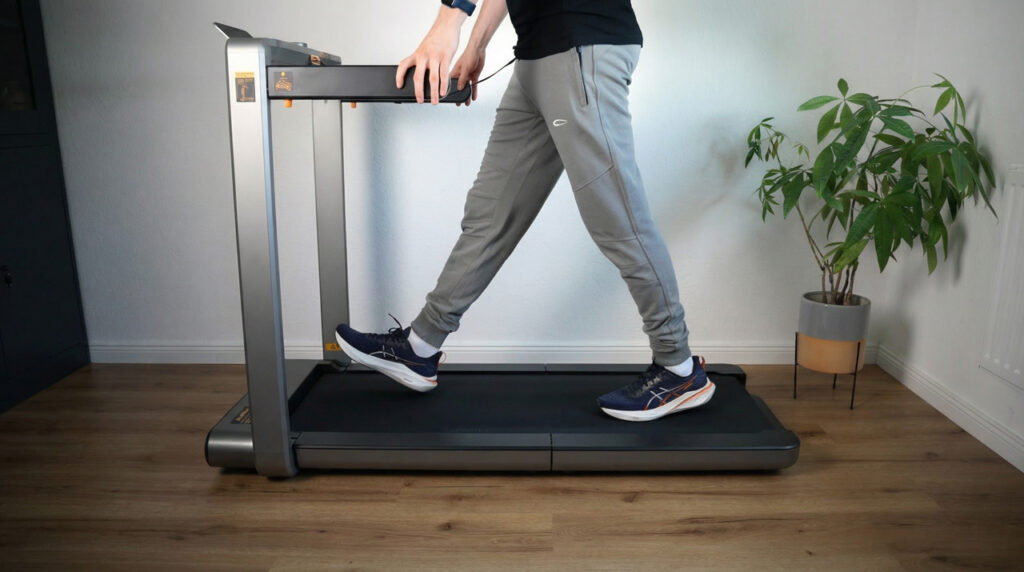
WalkingPad X214 Review The Best Upgrade for Home Office & Running?
Advertising: The product was provided to me for testing. My review remains unbiased and is based solely on my own experience and…
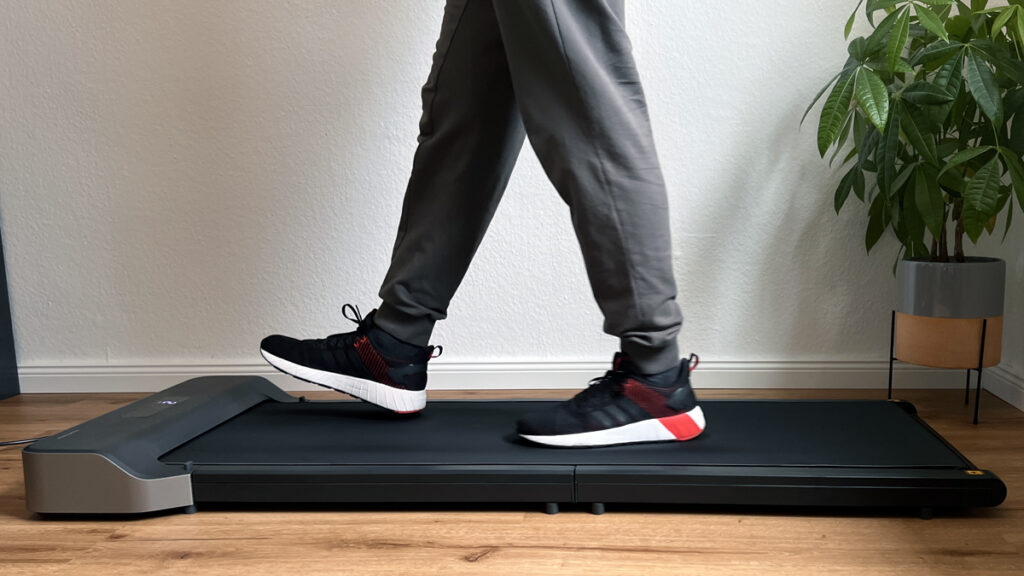
WalkingPad Z1 Review The Perfect Walking Pad for Most People!
Advertising: The product was provided to me for testing. My review remains unbiased and is based solely on my own experience and…
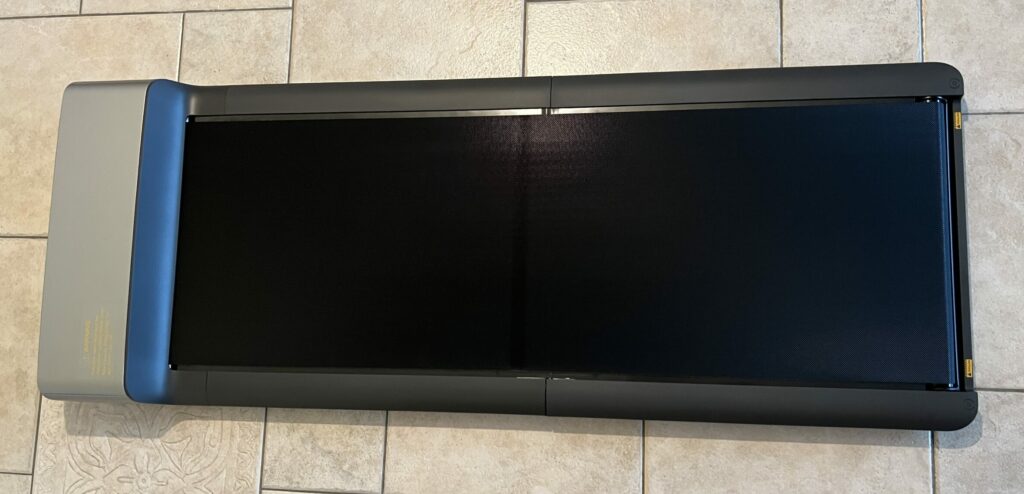
WalkingPad P1 Review A Reliable Folding Treadmill for the Desk!
Advertising: The product was provided to me for testing. My review remains unbiased and is based solely on my own experience and…
No cable at the workstation: how to solve it
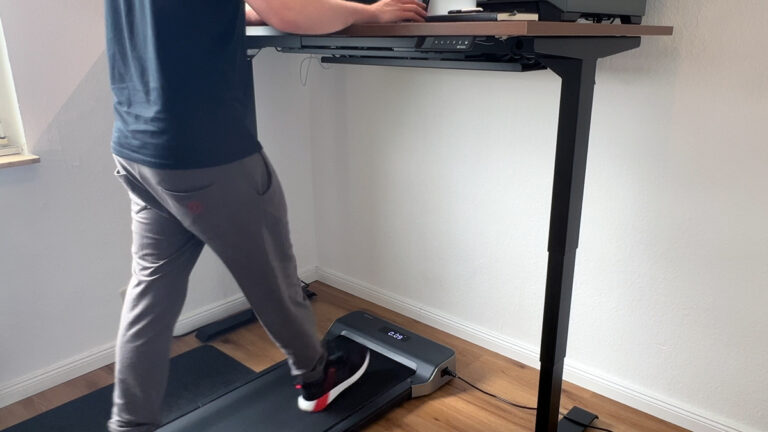
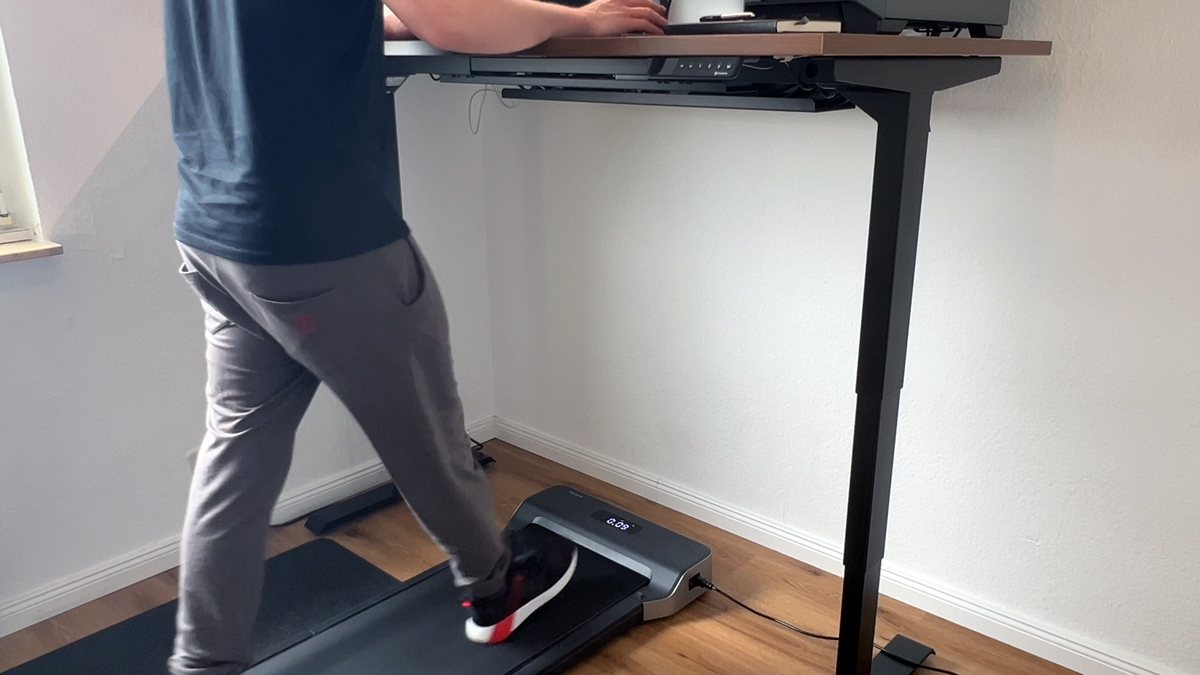
- Cable routing: The power cable exits at the rear on all models. With a cable tray on the desk or a floor cable duct it is out of the way.
- Remote instead of socket: Switching on and off, pace and stop run via remote on the P1, A1 Pro, Z3 Hybrid+, R2 and K1, via app on the X models. You do not have to go to the socket.
- Main switch: Switched off, the device draws practically no power. To be sure, switch off the main switch.
- Battery walking pads: I have not yet tested a walking pad with a battery. For two hours of walking a large, heavy battery would be needed, which contradicts the flat, light concept.
My verdict
A walking pad without electricity does not exist, and for the desk it would be no gain: the even, quiet motorised belt is exactly what makes working and walking at the same time possible. Electricity costs are a few cents per hour. You can see which models have proven themselves in the home office in my walking pad reviews.
Frequently asked questions about walking pads without electricity
Are there walking pads without electricity?
No. Flat walking pads for the desk always have a motor. Treadmills without electricity are curved or inclined sports devices that you have to drive yourself.
Can you use a manual treadmill under a desk?
Practically not. The belt only runs as long as you drive it with force, and the curved design with handrail does not fit under a desk.
How much electricity does a walking pad use?
Around 0.15 kilowatt hours per hour of walking, measured on the KUIPERS K1 and WalkingPad X214. That is about 6 cents per hour.
Are there walking pads with a battery?
Not in my tests. Hours of walking would need a large, heavy battery, all tested models run from a power socket.